GeoWorld: Providing Full-frame Geometry Features to Facilitate 3D Scene Generation

🔥 ECCV 2026

1VCIP & AAIS, Nankai University 2ByteDance Inc. 3Renmin University of China 4NKIARI, Shenzhen Futian
TL;DR: GeoWorld uses a two-stage video-generation pipeline with full-frame geometry features to produce high-fidelity image-to-3D scenes faster than prior methods (7.5x faster than Hunyuan-Voyager).

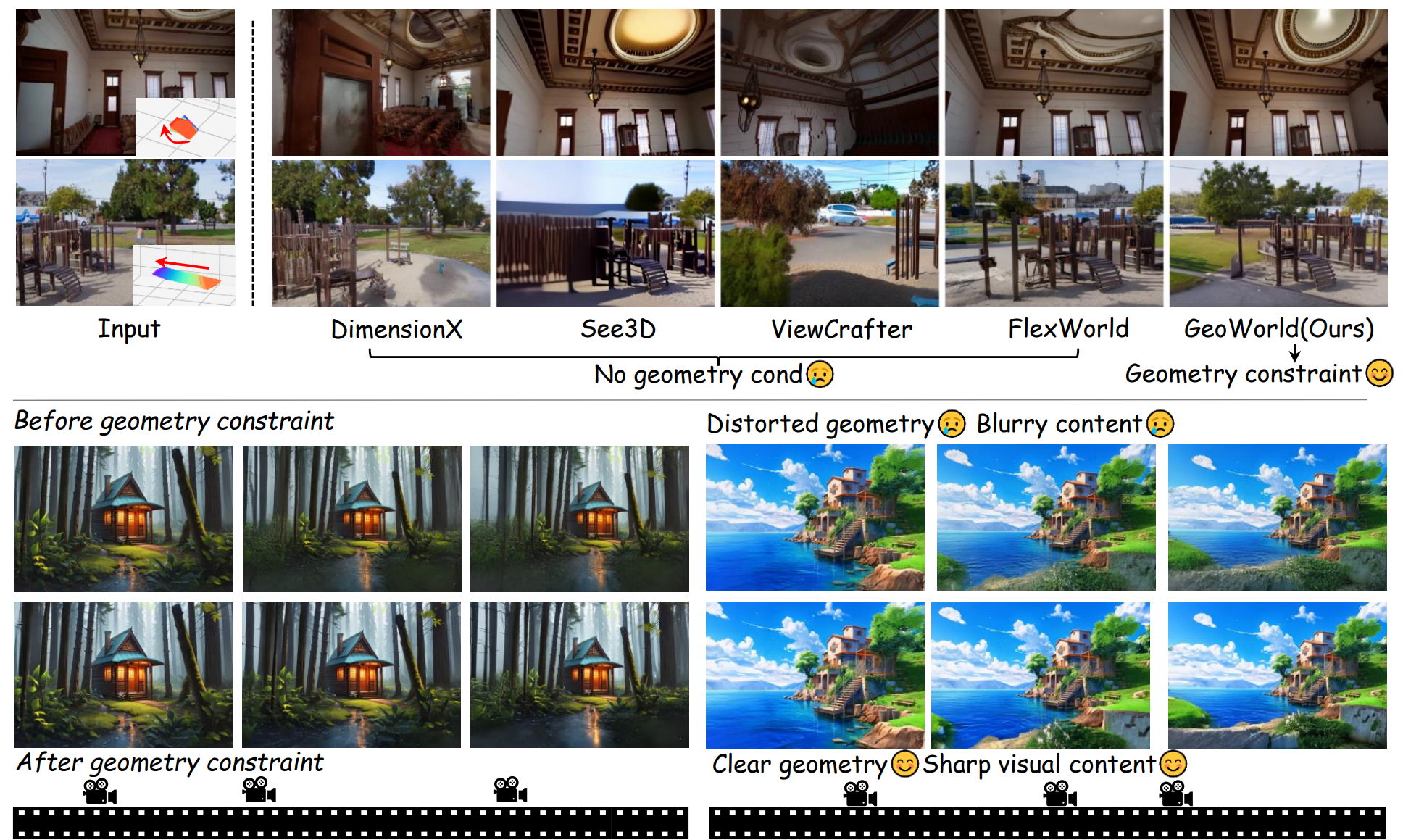
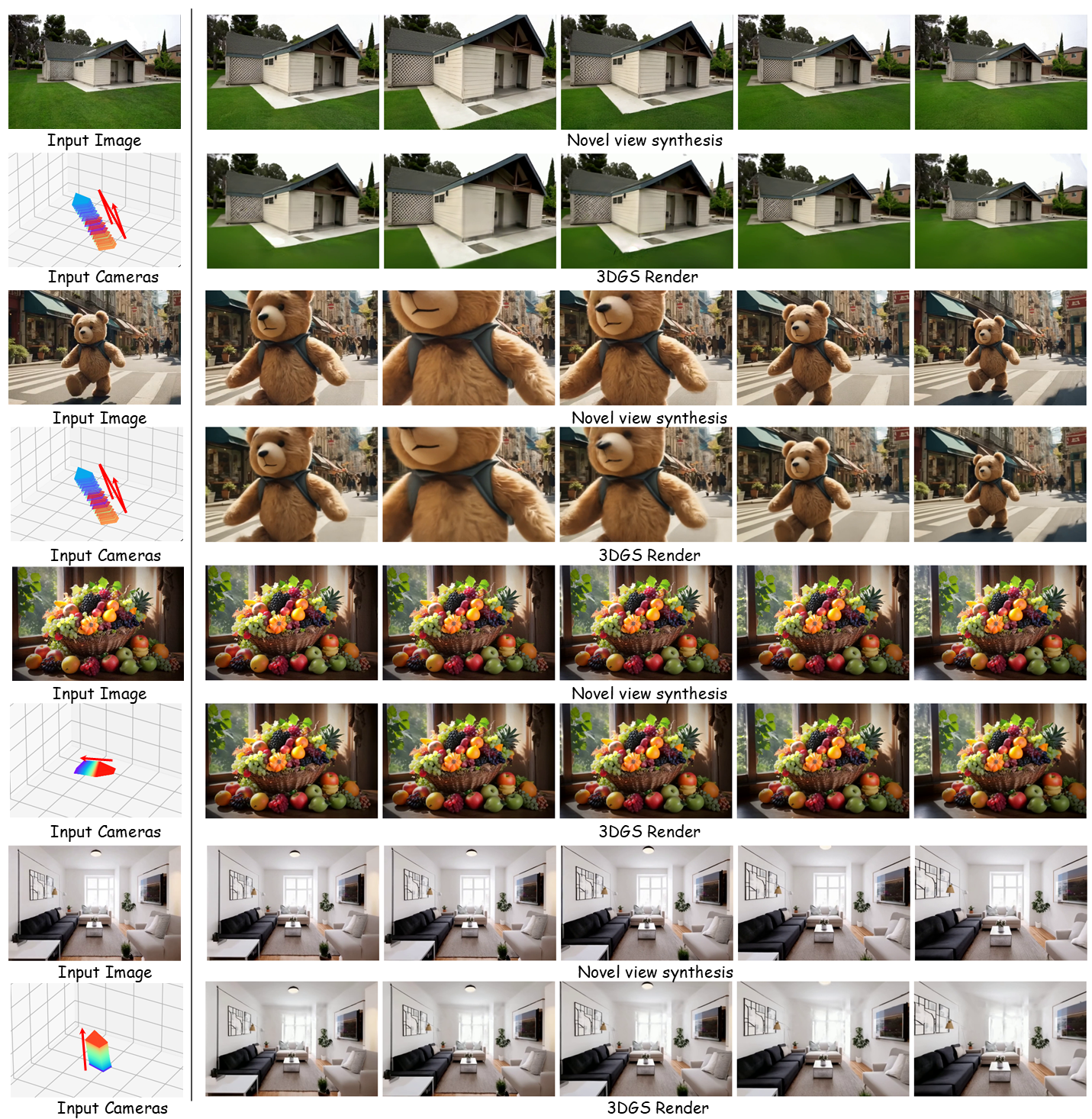
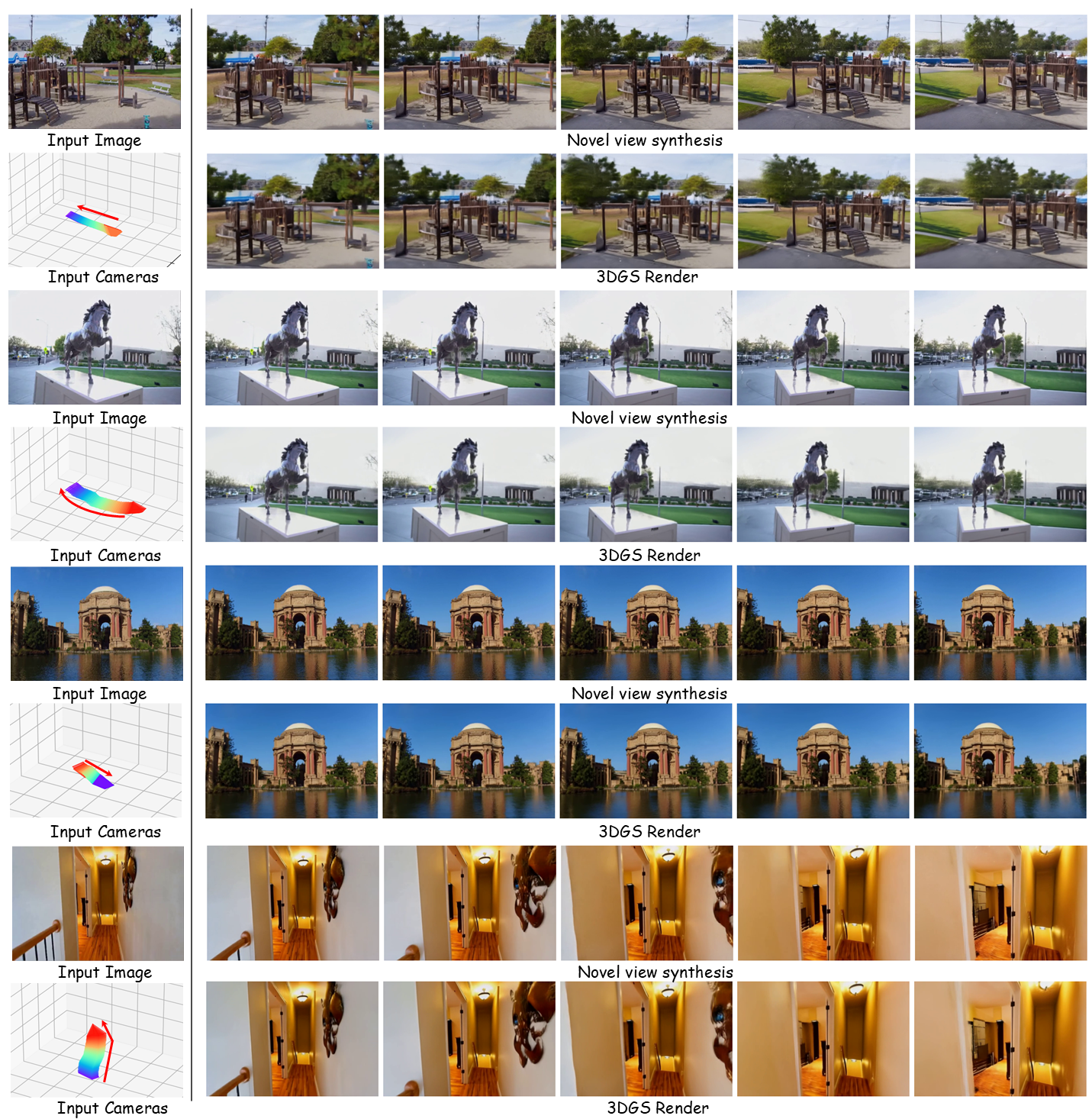
GeoWorld can synthesize novel-view images from arbitrary camera trajectories, which can then be used to reconstruct high-quality 3D scenes. Even under large viewpoint changes, GeoWorld is capable of producing high-quality results.

Why GeoWorld Works?

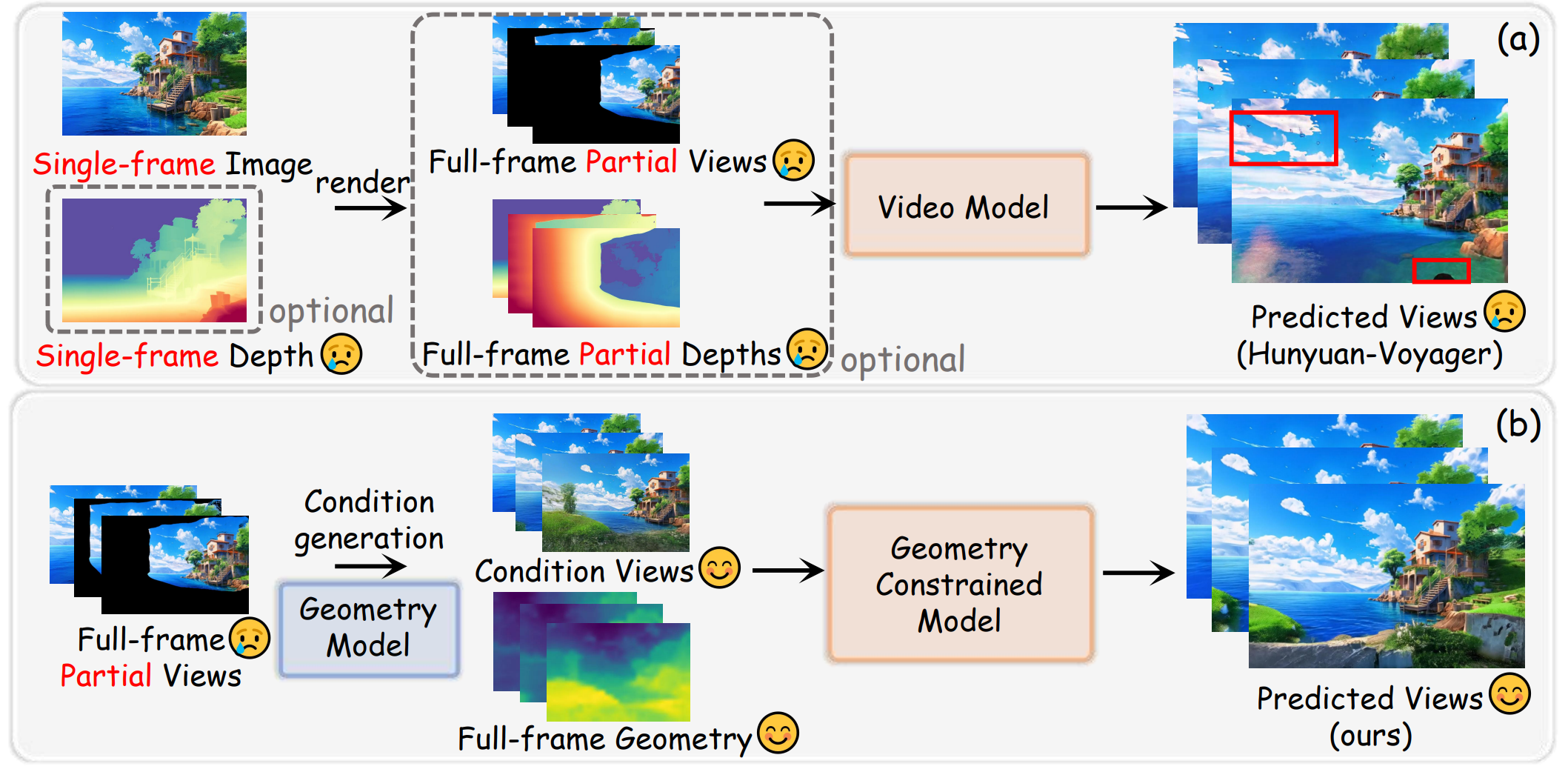
For GeoWorld, the first stage provides a mind draft for the second stage. During second-stage generation, the model starts from a video with complete content and refines it with the help of full-frame geometry features. For the model, this is much easier than directly imagining the entire scene from a single-frame input.

(a) Pipelines of previous methods. Although details vary, their video models are conditioned only on single-frame information and limited geometric information. "Optional" indicates that this step is not included in some methods. We can see that partial views or partial depths provide very limited information.

(b) Our GeoWorld leverages the geometrical condition generation procedure and a geometry model to obtain full-frame geometry features and condition views for generation, rather than relying solely on geometry extracted from the input image.
comparison image.

Comparisons to other methods

See3D FlexWorld Hunyuan-Voyager GeoWorld (ours)
Novel view synthesis
3DGS render

Abstract

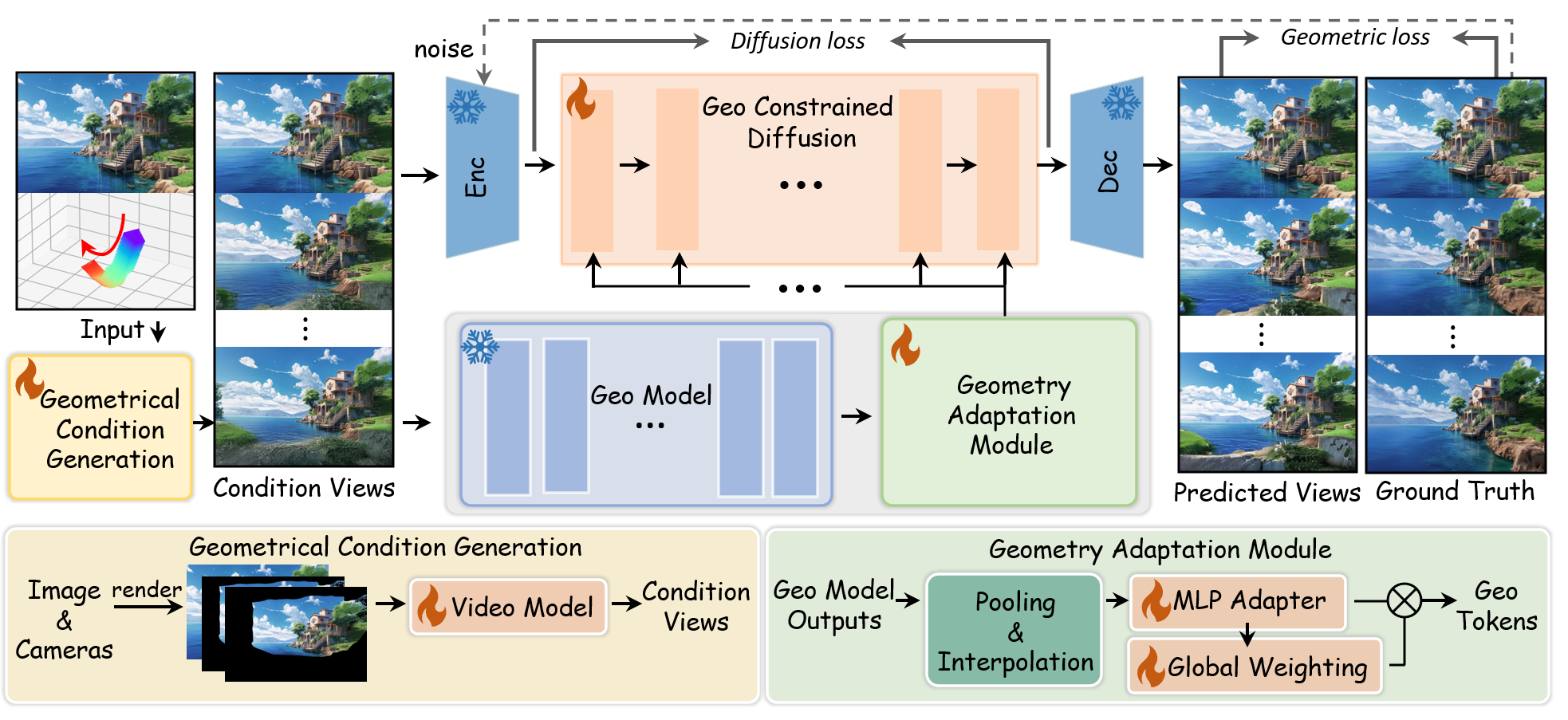
Previous works that leverage video models for image-to-3D scene generation often suffer from geometric distortions and blurry content. Using video generation models to implicitly maintain geometric consistency according to a single-frame input is ineffective. In this paper, we present a two-stage method, named GeoWorld, that renovates the image-to-3D scene generation pipeline by providing full-frame geometry features. The first-stage video generation model, followed by a multi-view geometry model, produces full-frame geometry features, which are then used as a mental draft of geometric conditions to aid the second-stage video-generation model. A geometric loss is proposed to impose real-world geometric constraints, and a geometry adaptation module is introduced to ensure the effective utilization of geometry features. Thanks to full-frame geometric modeling, the two smaller video models in our two-stage method can generate higher-fidelity 3D scenes than SOTA methods, while being even faster, e.g. 7.5x faster than Hunyuan-Voyager.

overview image.

Methods

GeoWorld employs a pipeline that differs from previous methods. It utilizes a geometry condition generation procedure to obtain condition views, which are then used to extract rich geometric information. Combined with the geometric loss and the geometry adaptation module, GeoWorld uses full-frame geometry features to facilitate generation, enabling results with clear geometry and sharp visual content.

pipeline image.

Video Results under Different Trajectories

Image Visual results

Our GeoWorld is capable of producing high-quality videos under various camera trajectories.
Thanks to the reliable geometric consistency across frames, the 3DGS renderings also show high-quality visual results.

BibTeX

@article{wan2025geoworld,
  title={GeoWorld: Unlocking the Potential of Geometry Models to Facilitate High-Fidelity 3D Scene Generation},
  author={Wan, Yuhao and Liu, Lijuan and Zhou, Jingzhi and Zhou, Zihan and Zhang, Xuying and Zhang, Dongbo and Jiao, Shaohui and Hou, Qibin and Cheng, Ming-Ming},
  journal={arXiv preprint arXiv:2511.23191},
  year={2025}
}